
Blog
Why Choose Trolley Rail for Your Material Handling System?
Material handling decisions shape daily production, not just equipment budgets. A Trolley Rail system can guide suspended loads along a defined route, helping keep floor space clear for workers, tools, and mobile equipment. In a workshop, that may mean moving a fixture from an assembly station to inspection without crossing a busy aisle. Small improvements like this can make a process easier to manage.
The right rail depends on the job. Load weight, trolley spacing, travel distance, curves, operating frequency, and the building structure all affect system design. A rail that looks suitable on a drawing may not perform well if its supports, clearances, or load limits are poorly matched to actual use. Measure the route. Check the details.
Trolley Rail systems can suit production lines, maintenance areas, and storage operations, but they are not automatically the best choice for every facility. Some routes change often; others need precise positioning or specialized lifting equipment. Those trade-offs deserve a closer look. Before choosing a system, compare the expected workflow with the rail manufacturer’s technical specifications, installation requirements, and maintenance guidance. A qualified material-handling professional can help verify loads and support conditions. Even then, the final layout may need adjustment after operators test it in real working conditions. That is not a flaw in planning; it is a practical reminder that good systems account for both engineering and the people who use them.
What Is a Trolley Rail Material Handling System?
Why Choose Trolley Rail for Your Material Handling System?
What Is a Trolley Rail Material Handling System?
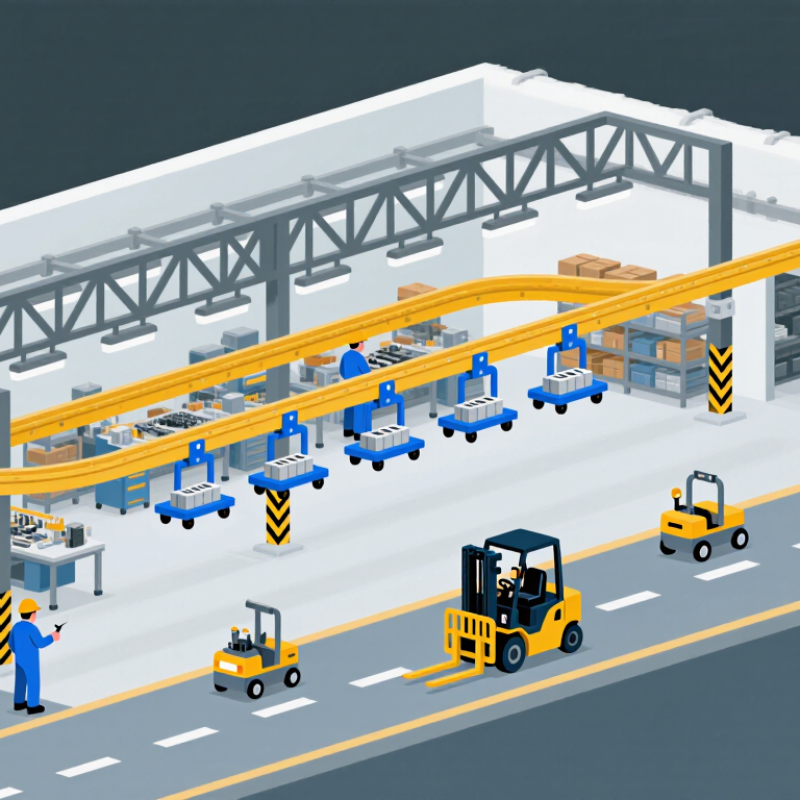
A trolley rail material handling system moves loads along a fixed track, commonly suspended above the floor. Trolleys carry parts, tools, or containers between workstations, storage areas, and production lines. Movement can be manual or powered, depending on load weight, travel distance, and production rhythm. In a workshop, for example, a trolley might carry a metal housing from a finishing station to inspection without occupying floor space. Simple, but not effortless.
The system’s layout follows the movement of materials. Straight rails suit repeatable routes; curves and switches can connect work zones, though they add design complexity. Engineers typically assess payload, support structure, clearance, trolley spacing, and how workers load and unload items. A rail can also become a constraint: changing the route later may require structural work. That detail is easy to underestimate.
Industry investment trends offer context, not proof of rail-system performance. MHI’s 2024 Annual Industry Report found that 88% of surveyed supply-chain professionals expected investment in supply-chain technology and innovation to rise over five years. The figure covers many technologies, not trolley rails specifically. For a facility, practical evidence comes from mapping daily load paths, measuring transfers, and checking whether the proposed route fits real operating conditions. Even a well-designed system may need adjustment after people use it.
Why Choose Trolley Rail for Your Material Handling System? - What Is a Trolley Rail Material Handling System?
| Dimension | Typical System Information | Why It Matters |
|---|---|---|
| What it is | A trolley rail system uses trolleys that travel along a fixed track to move suspended loads between workstations or process areas. | It creates a defined material route and can keep floor space available for people, equipment, and other traffic. |
| Main components | Track or rail, trolley wheels, load attachment (such as a hook or carrier), and supporting structure. Powered layouts may also include a drive, controls, and suitable load carriers. | Each component must be compatible with the load, route, environment, and chosen operating method. |
| Operating methods | Trolleys may be moved manually or by a powered conveyor arrangement. The appropriate option depends on load, travel distance, throughput, and process requirements. | Manual movement can suit simpler routes; powered movement can support repeatable, coordinated flow where the system is designed for it. |
| Load capacity | Capacity is system-specific and must be confirmed from the ratings of the track, trolley, supports, attachments, and any drive equipment. Include the weight of the load carrier and attachments in the suspended load. | The allowable system load is limited by the weakest applicable component and its rated installation conditions. |
| Route layout | Routes can be straight or include engineered curves, branches, and stops. Track geometry, clearances, supports, and transfer points are determined during system design. | A planned route helps connect process steps while avoiding obstructions and maintaining safe clearance from people and equipment. |
| Typical applications | Moving parts, tools, or products between workstations in settings such as manufacturing, assembly, finishing, and storage operations. | Suspended transport can be useful when items need to follow a repeatable path or when floor-level handling is inconvenient. |
| Potential benefits | Can reduce repeated floor-level transfers, establish a consistent material route, and make use of overhead space where the building and process allow. | Benefits depend on correct layout, safe loading practices, and integration with the workflow; they are not guaranteed for every operation. |
| Key design inputs | Maximum and typical load, load dimensions, required route, travel frequency, operating method, available headroom, building support conditions, and site environment. | These inputs help determine track selection, support requirements, clearances, controls, and suitable operating procedures. |
| Safety and maintenance | Follow applicable regulations and manufacturer instructions. Inspect track, supports, trolleys, attachments, and powered components according to the system’s requirements; do not exceed rated capacity. | Regular inspection and correct operation help identify wear, damage, or other conditions that could affect safe performance. |
| Best-fit check | Consider a trolley rail system when loads can be safely suspended and a fixed overhead route fits the building and workflow. Compare with floor conveyors, forklifts, or other handling methods during planning. | The best solution depends on load characteristics, process flexibility, site constraints, installation needs, and lifecycle requirements. |
Note: Capacity, layout, operating speed, and inspection intervals vary by system. Confirm project-specific values with a qualified designer and the equipment documentation.