Blog
China Top Laser Film Manufacturers for Global Buyers?
China has become a major sourcing base for Laser Film, serving display, packaging, security, and decorative applications. Its manufacturers offer broad material options, including PET, holographic, reflective, and electronically functional films. However, a large catalog does not guarantee dependable performance.
Buyers should examine more than factory size or attractive pricing. Film thickness, optical clarity, haze, adhesion, shrinkage, surface energy, and roll consistency directly affect production results. A sample may look excellent under showroom lighting, yet fail after lamination or prolonged heat exposure. That detail is often overlooked.
Optical-coatings authority Dr. J. A. Dobrowolski described coating design as “an exercise in compromise.” This principle applies to Laser Film manufacturing. Higher brightness may reduce flexibility. Stronger surface protection may affect transparency. Lower costs may limit inspection controls.
Reliable Chinese suppliers usually provide technical datasheets, batch records, test samples, and clear tolerance ranges. Experienced buyers should request performance evidence under realistic processing conditions. Ask how defects are measured. Ask how rejected rolls are handled. Ask whether production data remains traceable.
This guide explores China’s leading Laser Film manufacturers for global buyers. It considers product capability, quality systems, customization, export experience, and communication practices. Certifications matter, but they are not the entire story. Factory visits and independent testing can reveal weaknesses that documents miss.
No shortlist is perfect. Buyer requirements differ, and supplier claims require verification. The strongest choice is not always the cheapest or largest producer. It is the manufacturer that can repeatedly deliver stable film for the buyer’s actual process.
What Laser Film Is and Where It Is Used
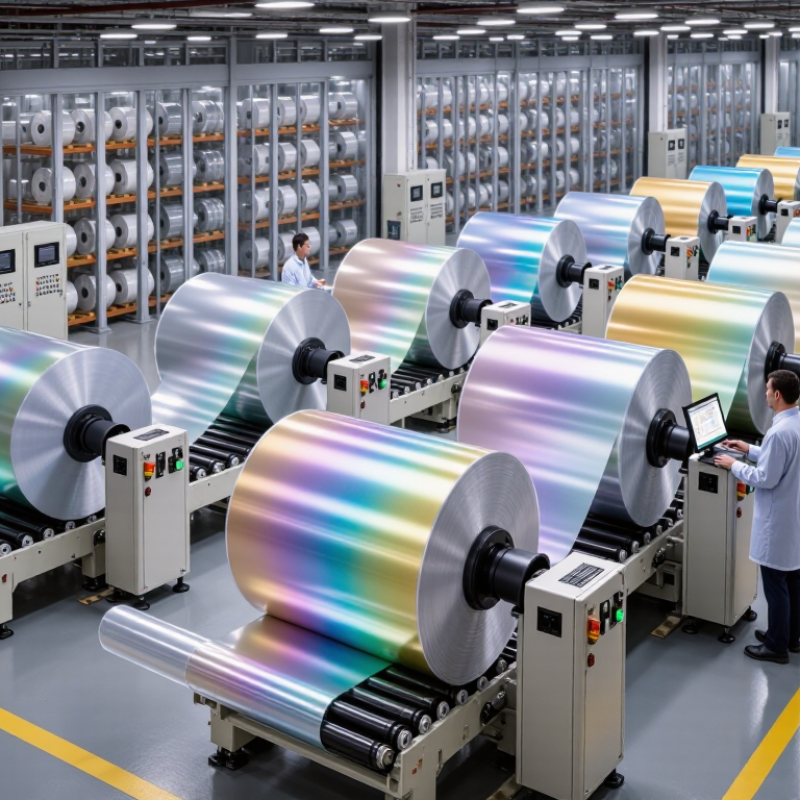
Laser film is a thin polymer film with microscopic optical patterns on its surface. These patterns bend and split light, creating shifting colors, depth, or a moving rainbow effect. Most laser films use PET or BOPP as the base layer. A coating, adhesive, or metalized layer may be added for different visual and functional results.
In practical production, laser film appears on flexible packaging, gift boxes, labels, decorative panels, and printed promotional materials. It can improve shelf visibility without adding heavy materials. Some films also support tamper-evident designs or visual authentication features.
However, a bright rainbow does not prove quality. Film clarity, adhesion, heat resistance, and converting performance matter more than appearance alone. Poor lamination can create bubbles, dull patches, or edge lifting.
Tips: Match the film to the printing and laminating process. Check thickness, surface energy, roll width, and storage conditions before ordering. Test the actual substrate, ink, adhesive, and temperature together. A sample may perform well in a showroom but fail during high-speed production. Ask for technical data, inspection records, and intended-use compliance documents. Also, review light exposure and moisture resistance if the finished product will face outdoor conditions. Small tests prevent expensive surprises.
Why Global Buyers Source Laser Film from China
Global buyers source laser film from China because the supply base combines broad material options with practical manufacturing experience. Factories commonly produce films with holographic, metallic, and diffraction effects for packaging, labels, decoration, and security-sensitive applications. Buyers can request different thicknesses, roll widths, adhesive layers, and surface finishes from one market.
In sourcing projects, I have seen small changes in coating thickness affect brightness, flexibility, and converting performance. Experienced manufacturers usually provide technical data, production samples, and test reports before mass production. They can also adjust processes for printing compatibility, heat resistance, and stable unwinding. However, not every supplier has the same control standards. A low quotation may hide inconsistent color, weak adhesion, or poor roll tension.
Reliable buyers normally compare samples under actual production conditions. They check gloss, optical effect, dimensional stability, and packaging protection. Factory audits can review raw material storage, inspection records, calibration routines, and batch traceability. Export experience also helps with documentation, labeling, and shipping coordination across different markets. Compliance still requires buyer attention, especially when films contact packaging or enter regulated applications. Some suppliers explain this clearly; others need persistent questions. That gap deserves careful review. Sample approval should remain separate from final acceptance, because performance can change during larger production runs.
How to Evaluate China’s Leading Laser Film Manufacturers
Global buyers should evaluate laser film suppliers through measurable performance, not showroom brilliance. Smithers’ Future of Packaging Films to 2028 estimates flexible packaging film demand will exceed 50 million tonnes annually by 2028. This growth increases pressure on suppliers to deliver stable optical effects at scale. Request samples from three production batches, not one carefully selected roll. Check holographic clarity, gloss, haze, color shift, coating adhesion, tensile strength, and roll-edge quality. Ask for test methods, equipment calibration records, and results linked to production dates.
The factory audit matters as much as the sample. Review cleanroom controls, embossing temperature records, coating-line speed, raw-material traceability, and corrective-action reports. For packaging applications, test oxygen and water-vapor transmission using recognized ASTM or ISO methods. A certificate alone is weak evidence. Independent laboratory testing is safer. The Flexible Packaging Association reports that packaging performance increasingly depends on downgauging and material efficiency, so thickness tolerance deserves close attention. A 5-micron variation can affect registration, converting, and waste.
Do not ignore commercial details. Compare minimum order quantities, lead times, spare-roll policies, and packaging for humid sea transport. Require a signed specification sheet and a pilot run before approval. A perfect sample can still mislead. Some buyers overvalue bright effects and underestimate aging, abrasion, or ink compatibility. That mistake is expensive. Also, sustainability claims need evidence: request recycled-content verification, chemical declarations, and lifecycle data rather than attractive wording. Perfect evaluation is impossible, but disciplined records make weak assumptions visible.
China Top Laser Film Manufacturers for Global Buyers? - How to Evaluate China’s Leading Laser Film Manufacturers
A practical, evidence-based comparison framework for evaluating anonymous Chinese laser film suppliers before sampling, qualification, and volume purchasing.
| Evaluation Dimension | Recommended Benchmark | Evidence to Request from the Manufacturer | Why It Matters to Global Buyers |
|---|---|---|---|
| Product Definition | Clearly specified laser film type, substrate, surface treatment, and end-use application | Technical data sheet showing whether the product is PET-based, PVC-based, PP-based, transfer film, decorative film, holographic film, or laser-marking film | “Laser film” describes several different product categories. A precise specification prevents buyers from comparing non-equivalent materials. |
| Substrate Thickness | Common PET range: approximately 12–250 μm | Thickness tolerance, measurement method, sampling plan, and independent test results | Thickness affects stiffness, dimensional stability, coating performance, converting behavior, and total material cost. |
| Thickness Tolerance | Defined tolerance stated on the product specification; tighter tolerances should be supported by process-control records | Coating-line control chart, incoming-material records, and at least three batch inspection reports | Uncontrolled thickness variation can cause wrinkles, uneven optical effects, inconsistent lamination, and waste during high-speed processing. |
| Film Width and Roll Format | Width, core size, outer diameter, winding direction, and roll length matched to the buyer’s equipment | Available width matrix, roll drawing, packaging specification, and photographs of finished rolls | Correct roll geometry reduces slitting losses, machine downtime, and compatibility problems at the converting site. |
| Optical Haze and Clarity | Target values defined according to the application; transparent decorative and overlay films normally require controlled haze and clarity | Haze and luminous-transmittance results measured according to ASTM D1003 or an equivalent recognized method | Optical uniformity directly influences visual quality, holographic brightness, readability, and defect visibility. |
| Gloss and Surface Appearance | Gloss level and visual appearance approved against a retained master sample | Gloss measurement data, defect classification standard, inspection lighting conditions, and approved limit samples | A written appearance standard is more reliable than subjective descriptions such as “high gloss” or “premium finish.” |
| Laser or Holographic Effect Uniformity | Consistent pattern registration, brightness, color shift, and defect rate across the usable roll length | Full-width sample, roll-start/roll-middle/roll-end inspection photos, pattern-registration records, and defect map | Uniformity across the entire roll is essential for packaging, security graphics, labels, and decorative applications. |
| Coating and Adhesion | Coating must remain attached during cutting, laminating, printing, bending, and intended environmental exposure | Cross-hatch adhesion results, tape test records, lamination trials, and technical information for the adhesive system | Poor adhesion can lead to delamination, ink failure, surface peeling, and costly customer claims. |
| Mechanical Performance | Strength, elongation, tear resistance, and dimensional stability matched to the converting process | Data generated under ASTM D882, ISO 527, or an equivalent standard, including machine and transverse directions | Mechanical data helps determine whether the film can tolerate printing, die-cutting, slitting, thermoforming, or lamination. |
| Dimensional Stability | Defined shrinkage or expansion limits after heat exposure and processing | Test temperature, dwell time, direction-specific results, and test method; for PET products, request data relevant to the intended process temperature | Dimensional change can cause registration errors, edge curl, wrinkles, and misalignment in multilayer products. |
| Printing Compatibility | Compatibility confirmed for the buyer’s printing method, such as gravure, flexographic, screen, offset, digital, or UV printing | Ink-adhesion test, surface-energy information where relevant, curing conditions, and printed trial samples | A film that performs well in one printing system may fail in another because of surface treatment and ink chemistry differences. |
| Surface Treatment | Corona, primer, hard coat, anti-static, release, or other treatment clearly identified and controlled | Surface-treatment specification, dyne-level records where applicable, treatment aging data, and storage recommendations | Surface treatment can change over time and directly affects printing, bonding, coating, and handling performance. |
| Environmental Resistance | Resistance requirements defined for humidity, heat, light, chemicals, and outdoor exposure according to the final application | Accelerated-aging reports, chemical-resistance tests, temperature range, and test duration; request ISO 4892-3 data when UV exposure is relevant | Laboratory data helps distinguish an indoor decorative product from a film suitable for demanding outdoor or long-life applications. |
| Color and Batch Consistency | Color, brightness, and optical effect controlled against an approved reference sample | Color-control records, ΔE limits where applicable, retained samples, and comparison data from multiple production batches | Stable batch performance is critical for repeat orders, coordinated packaging, and multi-site production. |
| Quality-Control System | Documented incoming, in-process, and final inspection | Inspection plan, calibration certificates, nonconformance procedure, corrective-action reports, and sample COAs | A certificate alone does not prove consistent quality. Buyers should verify how measurements are performed and how failures are handled. |
| Management Certification | ISO 9001 certification with valid scope and issuing-body verification | Current certificate, scope covering film manufacturing, certificate number, validity dates, and verification link or issuing-body record | Certification is useful evidence of a management system, but it should not replace product testing and factory qualification. |
| Regulatory Documentation | Applicable REACH and RoHS declarations supported by material records | Current declarations, restricted-substance test reports, safety data where applicable, and statements for inks, coatings, adhesives, and substrates | Regulatory compliance may involve every layer of a laminated structure, not only the base film. |
| Food-Contact Suitability | Only claim food-contact suitability when the complete structure and intended use are covered by applicable regulations | Migration testing, formulation declaration, intended-use limits, and documentation for all inks, coatings, adhesives, and substrates | A general “non-toxic” statement is not equivalent to food-contact compliance. |
| Sampling and Pilot Trial | Free or low-cost representative sample with defined sample identity | Sample lot number, production date, technical data sheet, trial guidance, and retained reference sample | Samples should be traceable to production material so that trial results can be connected to future bulk orders. |
| Minimum Order Quantity | MOQ agreed by film type, width, thickness, color, pattern, coating, and customized packaging | Formal quotation showing standard MOQ, custom MOQ, slitting charges, setup fees, and sample-order terms | MOQ can change substantially when a buyer requests a new pattern, coating, color, or special roll format. |
| Lead Time and Capacity | Lead time stated separately for standard stock, customized production, sampling, and repeat orders | Production schedule, monthly capacity statement, material-reservation policy, and recent on-time-delivery records | Capacity claims should be connected to actual line availability and the specific film construction being purchased. |
| Packaging and Export Protection | Moisture-resistant, impact-resistant, clearly labeled roll packaging suitable for international transport | Packaging specification, pallet dimensions, gross weight, loading photos, and instructions for storage and acclimatization | Improper packaging can cause telescoping, edge damage, moisture exposure, and surface contamination during transit. |
| Traceability | Each roll linked to a production lot and inspection record | Roll label format, lot-number rules, production records, COA template, and complaint-traceability procedure | Traceability enables targeted containment and root-cause analysis instead of rejecting an entire shipment. |
| Pre-Shipment Inspection | Inspection completed before dispatch against an agreed purchase specification | Pre-shipment inspection report, roll count, dimensions, appearance results, photos, and approved sampling level | Pre-shipment verification reduces the risk of receiving incorrect widths, mixed lots, damaged rolls, or nonconforming optical effects. |
| Commercial Transparency | Quotation clearly separates material price, tooling or pattern fees, slitting, packaging, testing, freight, and payment terms | Itemized quotation, Incoterms, payment schedule, validity period, warranty terms, and change-control procedure | Transparent pricing makes competing supplier offers easier to compare and reduces unexpected landed costs. |
| Recommended Qualification Decision | Approve only after document review, production sample trial, and agreed acceptance criteria | Completed supplier questionnaire, verified certificates, passed pilot trial, signed specification, and approved golden sample | The strongest supplier is not necessarily the lowest-priced option; it is the one that can repeatedly meet the buyer’s documented requirements. |

Key Products, Technologies, and Customization Options
China Top Laser Film Manufacturers for Global Buyers?
China’s leading laser film manufacturers offer holographic, diffraction, metallized, and transparent film products. These films support packaging, labels, gift wrapping, and decorative surfaces. Common substrates include PET, BOPP, and coated paper. Experienced buyers should check film thickness, surface tension, gloss, and roll stability. Production details matter.
Core technology often starts with precision laser mastering and micro-embossing. Roll-to-roll equipment helps maintain consistent patterns across long production runs. Vacuum metallization creates reflective effects without making the film excessively heavy. UV coatings can improve abrasion resistance, color stability, and moisture protection.
Quality teams should inspect samples under different lighting conditions. A pattern may look sharp indoors but weaken under direct sunlight. Not every prototype survives scale-up.
Customization usually covers pattern geometry, color tone, transparency, adhesive type, width, and winding direction. Buyers can request repeating designs, fine textures, or smooth metallic effects. Some manufacturers also adjust release coatings for easier transfer during packaging production. For export orders, ask for batch records, inspection standards, and storage recommendations. Reliable suppliers should provide trial rolls before mass production. A sample may look perfect, yet curl after humidity exposure. That weakness deserves testing. Clear specifications reduce costly rework and reveal whether the manufacturer can control both appearance and performance.
Quality Standards, Pricing, and Export Considerations
China’s laser film manufacturers serve buyers across packaging, labels, decoration, and security applications. Quality should be assessed through measurable specifications, not attractive samples alone. Check film thickness, haze, brightness, coating uniformity, adhesion, and roll winding. A 12-micron PET film may perform differently from another film with the same stated thickness.
Ask suppliers for recent inspection reports, batch numbers, and a clear certificate of analysis. ISO 9001-based procedures can indicate process discipline, but certification does not replace testing. Request samples from actual production lots. Test them under your printing temperature, lamination pressure, and storage conditions. Small defects become expensive at scale.
Pricing depends on resin costs, film structure, coating complexity, order quantity, and packaging. Compare quotations using the same thickness, width, core size, tolerance, and delivery term. A cheaper quote can hide higher waste or weaker adhesion. It happens. Include tooling, sampling, inspection, freight, customs duties, and insurance in the landed-cost calculation. Confirm payment terms carefully.
Export buyers should verify the HS code, commercial invoice, packing list, certificate of origin, and transport documents. Destination markets may also require material declarations or chemical compliance records. Clarify Incoterms and responsibility for damage before production begins. Confirm whether rolls need moisture barriers, edge protection, or reinforced pallets. Written specifications reduce disputes, although they cannot remove every risk. A pre-shipment inspection is often worthwhile for large orders. Forecasts are imperfect, so avoid excessive inventory until performance is proven.