
Blog
China Top 10 Steel Prefab House Manufacturers?
Choosing among China’s leading steel prefab house manufacturers takes more than comparing catalog photos. A clean rendering cannot show weld quality, insulation details, or how a wall panel fits after a long truck journey. Buyers should examine project experience, structural specifications, quality-control procedures, delivery scope, and after-sales support. Ask for drawings, material schedules, and references from completed projects.
Professor Mark Lawson, a researcher in modular construction, offers a useful perspective. In paraphrase, his work points to this practical rule: “Factory precision matters only when design, delivery, and site assembly work together.” This is a paraphrase, not a verbatim quotation. It highlights why factory capability alone cannot guarantee a successful build. Connections, weather protection, and installation planning matter, too.
This guide compares China Top 10 Steel Prefab House Manufacturers using practical criteria, not polished marketing claims alone. It considers product range, customization, documented standards, communication, and project suitability. Some suppliers focus on fast-deployable units; others provide larger modular buildings with more complex layouts. A low quoted price may exclude foundations, transport, or interior finishes, so confirm every line item. A ranking is never perfect. Company information changes, and a supplier that fits one project may not fit another. Use the list as a starting point, then verify current credentials, specifications, samples, and references directly.
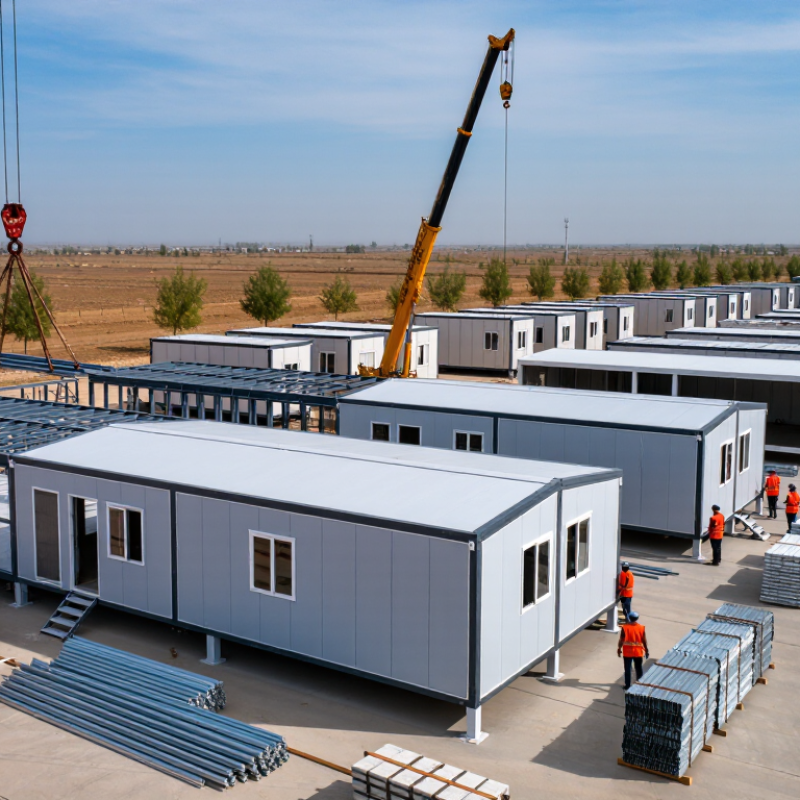
Steel Prefabricated Housing: Definition, Types, and Applications in China
Steel prefabricated housing uses factory-made steel frames, wall panels, floors, and roof components assembled at the project site. Much of the structure is prepared in a workshop, then transported for installation. Common systems include light-gauge steel homes, modular box units, and larger portal-frame buildings. They differ in frame size, insulation, finishes, and how much work is completed before delivery.
Some homes arrive as flat-packed panels; others use room-sized modules lifted onto prepared foundations. Light-gauge systems can suit compact residences and temporary site accommodation. Modular units are useful when projects need repeatable layouts, such as worker housing or rural clinics. Larger steel frames allow wider interior spaces, which can work for community buildings or small commercial facilities. The label “prefabricated” can be used loosely, so buyers should check what is actually factory-built.
In China, these buildings are used for construction-site accommodation, emergency facilities, tourism lodges, and housing in areas with limited building time. A unit intended for a cold northern winter needs different insulation and sealing from one used in a humid coastal region. Foundation design, drainage, fire protection, and local wind or seismic conditions also affect performance. Fast assembly is helpful, but it does not remove the need for sound site checks. A neat factory finish can still hide a poor connection.
How China’s Top 10 Manufacturers Are Identified and Ranked
A credible ranking of China’s steel prefab house manufacturers should begin with evidence, not a polished catalogue. The phrase “top 10” has no fixed meaning unless the selection criteria are disclosed. A useful review compares documented production capacity, engineering support, quality controls, delivery history, and after-sales service.
Each factor needs practical checks. Reviewers can examine factory audit records, inspect sample drawings, and ask how steel grades and connection details are verified. They should also compare project references with the proposed building type, such as worker accommodation or a small office.
Strong evidence includes dated inspection reports, clear specifications, and consistent answers from technical staff. Sales claims alone are not enough.
Then comes weighting. Product safety and structural documentation should matter more than showroom appearance or a low initial quote. Communication, customization limits, packaging, and delivery coordination also affect project outcomes.
Rankings should explain their scoring method and distinguish verified facts from company-provided information. Some evidence may be incomplete. That matters.
A manufacturer with less public information should not automatically be called unreliable, but its position should reflect the uncertainty. Reviewers should update results when new audits, completed projects, or service records become available.
Profiles of 10 Leading Chinese Steel Prefab House Manufacturers
These ten profiles are capability snapshots, not a verified ranking; without company names, buyers should treat them as starting points for research. Profile 1 focuses on light-gauge steel frames for compact homes. Profile 2 pairs structural design with factory-cut components. Profile 3 emphasizes modular rooms that arrive with interior finishes. Profile 4 serves projects needing larger spans and open-plan layouts. Profile 5 specializes in site offices and temporary accommodation. Profile 6 offers insulated wall and roof systems for varied climates. Details matter.
Profile 7 combines steel frames with panelized construction, which can simplify installation. Profile 8 highlights custom layouts, though changes may affect cost and lead time. Profile 9 supports export projects with packing plans and technical documents. Profile 10 offers broader design-to-installation coordination, where clear responsibility is essential. These descriptions reflect common supplier capabilities, not confirmed claims about specific companies. Ask for current drawings, steel specifications, coating details, and comparable project references. Check how the quoted price handles foundations, transport, and on-site assembly. A polished brochure is not proof. One weak point in any profile is the missing project context: local weather, crew skills, and maintenance needs can change what “best” means.
Comparison of Products, Services, Certifications, and Global Reach
Comparing China’s steel prefab house manufacturers means looking beyond attractive renderings. Examine frame thickness, coating type, insulation, fire performance, and connection details. Ask for drawings and test records for the exact model offered. McKinsey’s 2019 modular-construction report says suitable projects may cut schedules by 20–50%. That is potential, not a guarantee: transport, site access, and late design changes can erase some gains.
Services matter just as much as products. Check whether the supplier provides structural calculations, foundation guidance, installation training, spare parts, and after-sales support in your region. Confirm certification names, validity dates, and product scopes; a factory certificate alone may not cover the house system. A neat brochure is not proof. I would request a sample wall section and inspect its joints, insulation layers, and finish.
Global reach should mean more than past export destinations. Ask for references in similar climates, local code coordination, packing lists, shipping support, and a realistic response time for service. The World Green Building Council’s 2019 report attributes about 39% of global energy-related carbon emissions to buildings and construction, including roughly 11% from materials and construction. So compare insulation and material disclosures, not just steel weight. Some suppliers may not share comparable data; that gap deserves attention.
Key Factors for Evaluating and Selecting a Manufacturer
When comparing steel prefab house manufacturers, look beyond low prices and polished catalogs. Ask for drawings that show column spacing, roof loads, connection details, and steel grades. A credible supplier should explain how its design suits your site’s wind, snow, humidity, and intended use. Request recent project references and speak with a previous buyer, if possible. Photos help, but inspection records and specific material specifications offer stronger evidence. Details matter.
Tips: Ask how steel is protected against corrosion, especially near the coast. Confirm insulation options, window specifications, packaging methods, and what the quoted price excludes. Get delivery stages and change procedures in writing. Ask for proof.
Factory capacity matters, but so does communication. Send one clear layout and note how quickly the manufacturer answers technical questions. Compare responses for precision, not just speed. If answers about tolerances, quality checks, or installation support remain vague, pause before paying a deposit. A polished brochure can still hide gaps in execution. Even a thorough review cannot remove every risk; timelines may shift, and site conditions can change. Keep a written record of decisions, approved drawings, and inspection points, so both sides can resolve discrepancies against the same information.
China Top 10 Steel Prefab House Manufacturers? - Key Factors for Evaluating and Selecting a Manufacturer
This comparison table provides a practical framework for assessing manufacturers; it does not rank or identify specific companies. Requirements and benchmarks should be checked against the project location, applicable building codes, design, and contract.
| No. | Evaluation Factor | What to Check | Evidence to Request | How to Evaluate |
|---|---|---|---|---|
| 1 | Relevant Project Experience | Experience with comparable building types, spans, storeys, climates, and intended uses. | Project references, completion records, photographs, and client contacts where available. | Give stronger consideration to completed projects that match the proposed scope and site conditions. |
| 2 | Design and Engineering Capability | Ability to provide coordinated architectural, structural, and connection details for the project. | Sample drawings, design responsibility matrix, engineering calculations, and applicable professional credentials. | Confirm who is responsible for design, approval, revisions, and coordination with local engineers. |
| 3 | Code and Permit Readiness | Capacity to design and document the building for the destination’s applicable codes and approvals. | Code-compliance schedule, product documentation, test reports, and local approval support plan. | Check requirements with the relevant authorities and qualified local professionals; do not assume one certificate covers every jurisdiction. |
| 4 | Steel and Material Traceability | Specified steel grades, coating systems, fasteners, insulation, and other key materials. | Material specifications, mill test certificates where applicable, coating data, and supplier records. | Match delivered materials to the approved specifications and require clear procedures for substitutions. |
| 5 | Quality Management and Inspection | Documented production controls, inspection stages, nonconformance handling, and traceable records. | Quality procedures, inspection and test plans, sample inspection reports, and relevant current certificates. | Verify the certificate’s scope and validity, and assess actual inspection records rather than relying on a certificate alone. |
| 6 | Factory Capacity and Production Planning | Available production capacity, equipment, workforce, and ability to meet the project schedule. | Production plan, milestone schedule, capacity information, and factory audit or inspection arrangements. | Compare the proposed schedule with drawings approval, procurement, fabrication, inspection, and dispatch milestones. |
| 7 | Scope and Price Transparency | Whether the quotation clearly defines included and excluded work, quantities, specifications, and assumptions. | Itemized quotation, scope matrix, technical proposal, payment schedule, and change-order terms. | Compare equivalent scopes and identify costs for foundations, installation, shipping, taxes, and site services separately. |
| 8 | Packaging, Shipping, and Delivery | Export packing, loading plan, shipping documents, delivery terms, and coordination with site access. | Packing list example, loading plan, proposed delivery schedule, and clearly stated Incoterms® rule and named place. | Confirm responsibility for freight, insurance, customs clearance, unloading, and risk transfer in the contract. |
| 9 | Installation and Technical Support | Availability of assembly drawings, installation guidance, training, supervision, or on-site support. | Installation method statement, crew qualifications where relevant, support plan, and spare-parts proposal. | Clarify who supplies labor and equipment, who manages site safety, and how technical issues are escalated. |
| 10 | Warranty, Service, and Contract Risk | Warranty coverage, exclusions, response process, remedies, and allocation of project risks. | Draft warranty terms, service contact process, contract schedule, and documented claims procedure. | Review coverage periods and remedies in writing, and have the final contract checked for the governing law and dispute provisions. |
