
skip to Main Content

What Are the Top 10 Optical Sorter Applications in China?

Optical sorting is becoming an important quality-control tool across China’s food, mining, and recycling industries. Cameras, sensors, and software inspect products at high speed, helping remove discolored grains, stones, unwanted plastics, and other visible contaminants. The equipment is not a universal fix. Results depend on product presentation, lighting, sensor settings, and the quality of incoming material.

The scale of Chinese production helps explain the interest. The National Bureau of Statistics of China reported that national grain output reached 706.5 million tonnes in 2024, up 1.6% from the previous year. Large volumes make consistent inspection valuable, though they do not prove that every processor uses optical sorting. There is a gap between industry need and actual adoption. It deserves attention.

Recycling offers another clear use case. The Global E-waste Monitor 2024, published by UNITAR and the International Telecommunication Union, estimated that China generated 12 million tonnes of e-waste in 2022. Optical systems can help identify and separate selected materials, but complex products still require careful processing and downstream checks. These figures describe industrial context, not optical-sorter sales or market share. This article examines ten Optical Sorter Applications in China, from grains and nuts to minerals and recyclable materials, and considers where the technology fits—and where human oversight remains essential.
What Are the Top 10 Optical Sorter Applications in China?

What Optical Sorters Are and How They Work

What Are Optical Sorters and How Do They Work?

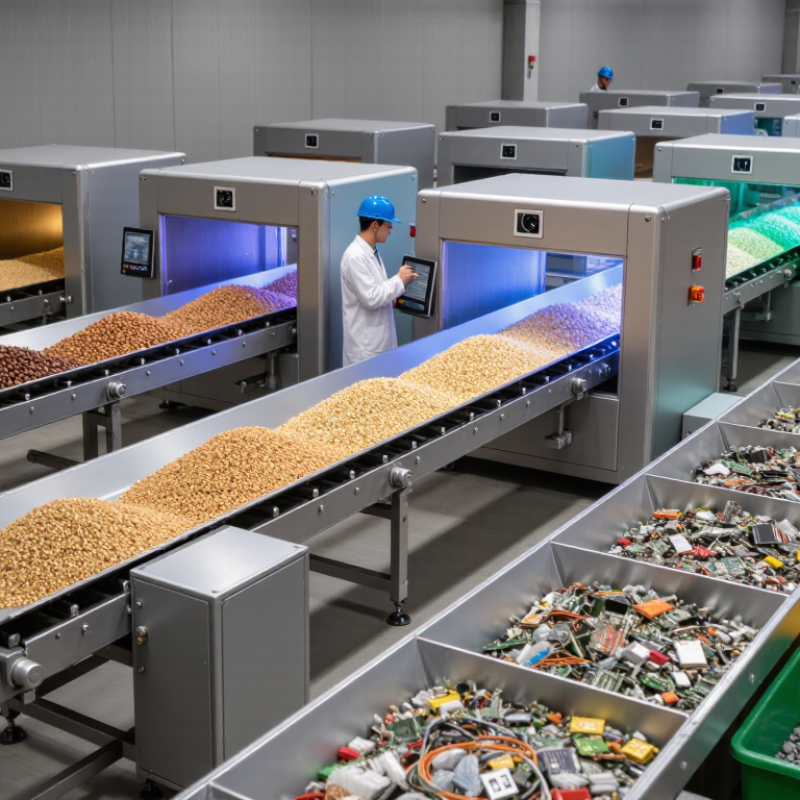
Optical sorters inspect products as they move along a production line. A feeder spreads rice, nuts, or cut vegetables into a thin, steady stream. Cameras capture each item under controlled lighting. Software compares its color, shape, size, or spectral response with preset criteria. Near-infrared sensors can detect differences that ordinary color cameras may miss. When an item meets a rejection rule, a precisely timed air jet pushes it into a separate chute. The rest continues forward. It happens in milliseconds. Clean lenses and stable feeding matter; crowded or dusty products can confuse detection.

The FAO’s 2019 State of Food and Agriculture report estimated that 14% of food was lost between post-harvest stages and retail, using 2016 data. This is a global food-loss estimate, not a measure of sorter performance. In Chinese processing plants, sorting can help remove discolored grains, foreign material, or damaged produce before packing. Operators still need to set thresholds for each crop and inspect rejected material. A strict setting may discard usable food; a loose one may let defects pass. That trade-off is easy to underestimate. Optical sorting supports quality control, but it does not replace careful handling, cleaning, or routine sampling.

What Are the Top 10 Optical Sorter Applications in China? — What Optical Sorters Are and How They Work

Optical sorters use cameras and sensors to identify differences in color, shape, or other material properties, then separate items with targeted air jets or mechanical systems. Common applications include sorting rice, wheat, corn, beans, nuts, tea, dried fruit, fresh produce, recyclable plastics, and minerals.

The chart shows 2023 output—not optical-sorter sales, installations, or market share—for selected Chinese crops commonly handled by optical sorting. It provides production context rather than ranking the applications by sorter use.

Source: National Bureau of Statistics of China, 2023 crop production data. Values are approximate and shown in million tonnes.

Which Materials and Defects Optical Sorters Can Detect

What Are the Top 10 Optical Sorter Applications in China?

Which Materials and Defects Optical Sorters Can Detect

Across China, optical sorting is used for rice, wheat, maize, tea, nuts, seeds, dried foods, vegetables, seafood, and mineral processing. In grains, cameras can flag dark kernels, discoloration, broken pieces, and visible insect damage. Near-infrared sensors can distinguish materials by spectral response, while X-ray systems can reveal dense foreign objects or some internal defects. Detection depends on the material, sensor setup, and how consistently items pass the inspection point. A shiny stone and a dark grain may look similar to a basic camera.

China’s National Bureau of Statistics reported grain output of 706.5 million tonnes in 2024. That scale makes reliable inspection valuable, but output figures do not measure sorter performance. The FAO’s 2023 report estimated that 13.2% of the world’s food was lost between harvest and retail in 2021; this is global context, not proof that sorting alone prevents losses. A blind spot remains. Standard color cameras cannot reliably identify every toxin, hidden mold, or chemical residue. Even advanced systems need validation against physical samples, especially when crop varieties, moisture, and lighting change. Operators should test real production lots and track false rejects, not just removal rates.

The Top 10 Optical Sorter Applications in China

China’s optical sorting market serves both food processing and industrial recovery. These ten applications reflect common technical use cases, not a verified ranking by sales. The National Bureau of Statistics reported 706.5 million tonnes of grain output in 2024, underscoring the scale of crop handling. FAO’s The State of Food and Agriculture 2024 estimated that 13.2% of food was lost after harvest and before retail in 2021. Optical sorting can help remove visible defects, but it cannot solve every cause of food loss.

The leading applications include rice, wheat and other grains; seeds; tea; peanuts and tree nuts; dried fruit; fresh produce; frozen foods; spices; recyclable plastics; and industrial minerals. In a rice line, cameras can identify discolored kernels as they pass through a chute, while air jets eject selected pieces into a separate bin. Tea processors may sort by color and shape, but leaf variation can make settings difficult. Plastics facilities use optical systems to separate materials by color or type, supporting cleaner downstream batches.

Performance depends on feed consistency, lighting, camera settings and cleaning routines. A sorter works best when material is spread into a steady, thin stream. Wet, overlapping or similarly colored items can still confuse the system. That matters. Operators should test representative samples and track rejection rates; an attractive demo does not guarantee stable results on a busy production line.

What Are the Top 10 Optical Sorter Applications in China?

No. Application Typical Materials Common Sorting Targets Why Optical Sorting Is Used
1 Rice processing Milled rice, including long-grain and short-grain varieties Discolored kernels, damaged grains, foreign seeds, and other visible defects Helps improve product appearance and remove unwanted material from high-throughput processing lines.
2 Wheat and flour-milling grain preparation Wheat kernels and other cereal grains Discolored or shriveled kernels, weed seeds, and selected foreign materials Supports grain cleaning and helps reduce unwanted material before further processing.
3 Tea processing Processed tea leaves and tea buds Stems, yellowed leaves, foreign matter, and pieces with contrasting color or shape Can sort delicate, irregularly shaped products using differences in color, shape, or spectral response.
4 Nuts and dried fruit Peanuts, sunflower seeds, beans, raisins, and similar products Mold-affected, discolored, damaged, or shriveled pieces and foreign materials Provides consistent inspection across large volumes and can help remove visually or spectrally different pieces.
5 Fresh and frozen vegetables Peas, beans, corn kernels, diced vegetables, and similar products Plant debris, off-color pieces, damaged product, and certain foreign materials Enables inspection of individual pieces on a moving line, including after cutting or freezing.
6 Fruit processing Whole or cut fruit, such as citrus, apples, and berries Visible blemishes, abnormal color, damaged pieces, and non-fruit material Automated optical inspection can sort products by visible characteristics at processing-line speeds.
7 Plastic recycling Sorted plastic flakes or containers, including PET and other common polymer streams Different polymer types, colors, and non-plastic contaminants, depending on the sensor system Near-infrared and color-sensing systems can help separate recyclable materials into more consistent streams.
8 Mineral and ore processing Run-of-mine rocks, industrial minerals, and prepared ore particles Particles with different color, brightness, texture, or other detectable surface characteristics Sensor-based sorting can reject selected waste rock before energy-intensive crushing or grinding stages.
9 Salt processing Refined and industrial salt crystals Dark particles, visible foreign matter, and crystals with contrasting appearance Helps remove visually distinct contaminants from granular product streams.
10 Waste and construction-material recovery Mixed packaging, glass cullet, and selected construction and demolition materials Material types, colors, and unwanted fractions identifiable by the installed sensor configuration Supports material recovery by separating selected fractions from mixed, processed feed.

Applications are representative examples, not a market-share ranking. Sorting performance depends on the material, feed condition, sensor configuration, and processing-line setup.

How Optical Sorting Benefits Chinese Industries

Optical sorting helps Chinese industries remove defects, separate materials, and keep production lines moving. In grain plants, cameras inspect kernels as they cross a fast belt; timed air jets eject discolored or foreign pieces. China’s National Bureau of Statistics reported 695.41 million tonnes of grain output in 2023. At that scale, even small improvements in inspection consistency can matter. They do not guarantee better food safety, though; sampling and process controls remain essential.

FAO’s 2023 food-loss update estimated that 13.2% of food was lost between harvest and retail worldwide in 2021. Optical sorting can help processors detect damaged produce, but it cannot prevent every loss caused by storage or transport. In recycling plants, sensors can separate plastics by material or color, making downstream batches more uniform. Mineral processors can also use sensor-based separation to reject some low-value rock before energy-intensive grinding. The gains depend on feed quality, calibration, and maintenance. Small details matter. Dust on a lens or mixed materials can weaken results. Not magic. Chinese operators should test sorter performance against their own waste, energy, and quality data before expanding a line.

What to Consider When Choosing an Optical Sorting System

What Are the Top 10 Optical Sorter Applications in China?

What to Consider When Choosing an Optical Sorting System

Choosing a system starts with the material, not the machine’s headline speed. Chinese processors handle grains, tea, nuts, plastics, and minerals, each with different colour, size, and surface variations. FAO estimated that 13.2% of food was lost globally before retail in 2021 (The State of Food and Agriculture 2023). Sorting can help remove defects, but it cannot recover food damaged during harvesting or storage.

Ask how the system detects your actual defects: colour cameras may miss internal damage, while other sensors can distinguish materials by composition. Request trials using representative samples, including dusty pieces and mixed batches. Check accuracy and throughput together; a fast line is less useful if good product is rejected. Small details matter. Confirm that operators can adjust settings, clean lenses, and replace parts without long stoppages.

For plastics, separation performance deserves close attention. The OECD’s Global Plastics Outlook (2022) estimated that only 9% of plastic waste was recycled globally in 2019. Optical sorting is one part of that chain, not a complete recycling solution. Compare reject rates, energy use, maintenance needs, and integration with existing conveyors. A polished demonstration can mislead. Real feed varies, and I would weigh a measured trial more heavily than a catalogue claim.